


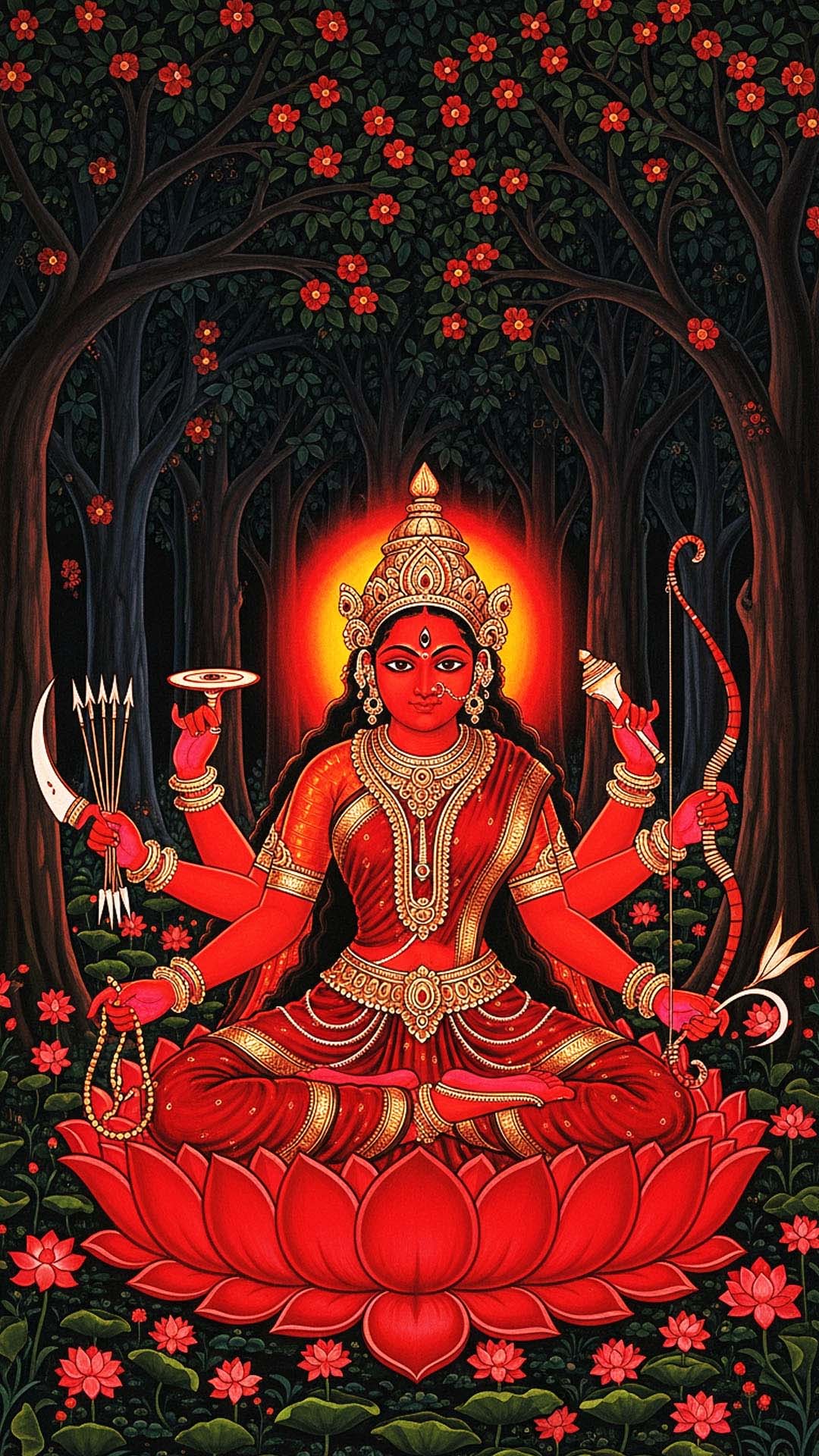
The following passages from the Kāmakalāvilāsa and the Cidvallī commentary specifically detail the nature, appearance, and cosmic function of Mahātripurasundarī.
The Nature of Mahātripurasundarī as the Supreme Power
"Śiva is the Supreme Self, the instigator of all. At the beginning of the Kṛta Yuga, He gave this knowledge to Her—that Power (Śakti) who grants limitlessness and bliss to all beings. The Rahasyopaniṣad states: 'Brahmā, Viṣṇu, Rudra, Vāṇī, Lakṣmī, and Bhavānī are the transmitters of the tradition in sequence. As the progenitor of all worlds, She alone is Tripurā, and She alone grants Bliss.' She is the one who transmits the knowledge of one's own nature, the form of Reflection (Vimarśa). She is the supreme form of Power who is the resting place of unsurpassed Bliss. As stated in the Upaniṣad: 'She is Desire (Kāmā), fulfilling all desires; Desire is the world, Desire is the cities; therefore, She is Tripurā.'"
The Manifestation in the Uḍḍiyāna Pīṭha
"At the beginning of the Kṛta Yuga, ParamaŚiva Himself, residing in the central Bindu which is the Uḍḍiyāna Pīṭha, being named Śrī Caryānandanātha, is the first Guru, His body reflected upon by Śrī Mahātripurasundarī, who is His own Self-Power. Thus it is said: The one possessing the body of Kāmarāja, situated in the Uḍḍiyāna Pīṭha within the triangle, attained the state of the letter-less form from the center of the symbolic triangle."
The Union of Prakāśa and Vimarśa
"She is the Vimarśa Śakti (Power of Reflection) inseparable from Kāmeśvara. Kāmakalā is that very Lady, the Beautiful one; Her dalliance is in the form of the enclosure deities of the Chakra and the rest. That very dalliance is the transformation of the mind at the time when the beloved is seen. For ParamaŚiva who faces the vision of His own Power, the dalliance of Kāmakalā, who is the Power of Consciousness (Cicchakti), provides limitless bliss in the form of the movement of Her feet and the rest. The Kāmakalā-vilāsa, in the form of the text emerged from His own lotus-face in the form of Āryā verses, serves for the union with the love of ParamaŚiva."
Mahātripurasundarī as the Source of All Vidyā
"The universe consists of the five elements; She consists of them, O Sinless one. The Root-Knowledge (Mūlavidyā) also consists of them. This is the Primordial Knowledge (Ādi-Vidyā), which emerged from the lotus-face of ParamaŚiva and is the cause of everything. She, the aforementioned life-mistress of ParamaŚiva, became the form of the three Gurus of the three ages and set the tradition in motion. She is the presiding mistress of the stations: the apex corner, the right corner, and the northern corner of the central triangle, which are the abodes of Kāmeśvarī, Vajreśvarī, and Bhagamālinī."
Meditation and Worship of the Goddess
"Meditation upon the Goddess situated in the midst of the Great Lotus Forest, the embodiment of the Bliss of the Cause; and on the Guru's Sandals (Guru Pādukā) in the Vāgbhava portion, which find refuge in Her limbs. Thinking of Her who nourishes the form of the universe and showers supreme nectar, while reeling with the intoxication of the sentiment of supreme non-duality. To Her who is situated in the midst of the Great Lotus Forest, the embodiment of the Bliss of the Cause, the Goddess who finds refuge in my lap and grants the fruit of all desires and will—one should worship You with offerings of food and the rest that consist of You alone."
The Identity of the Self and the Goddess
"This very Knowledge of the Self, which grants identity with the Self, was given to Her—to Kāmeśvarī. She is His own Self-Power, the giver of the highest Self-knowledge. She alone creates, protects, and withdraws these beings, or She does otherwise. She is the red womb of the universe, the progenitor of the world. Therefore, the Śāmbhava vision has been expanded upon as that which is to be worshipped only by those desiring liberation, leading to the realization of the oneness of Consciousness and the attainment of the supreme abode of Tripurā."